







Do you have questions about spare parts,
automation, consulting, or machinery?
We’re here to help!
Machine Retrofit
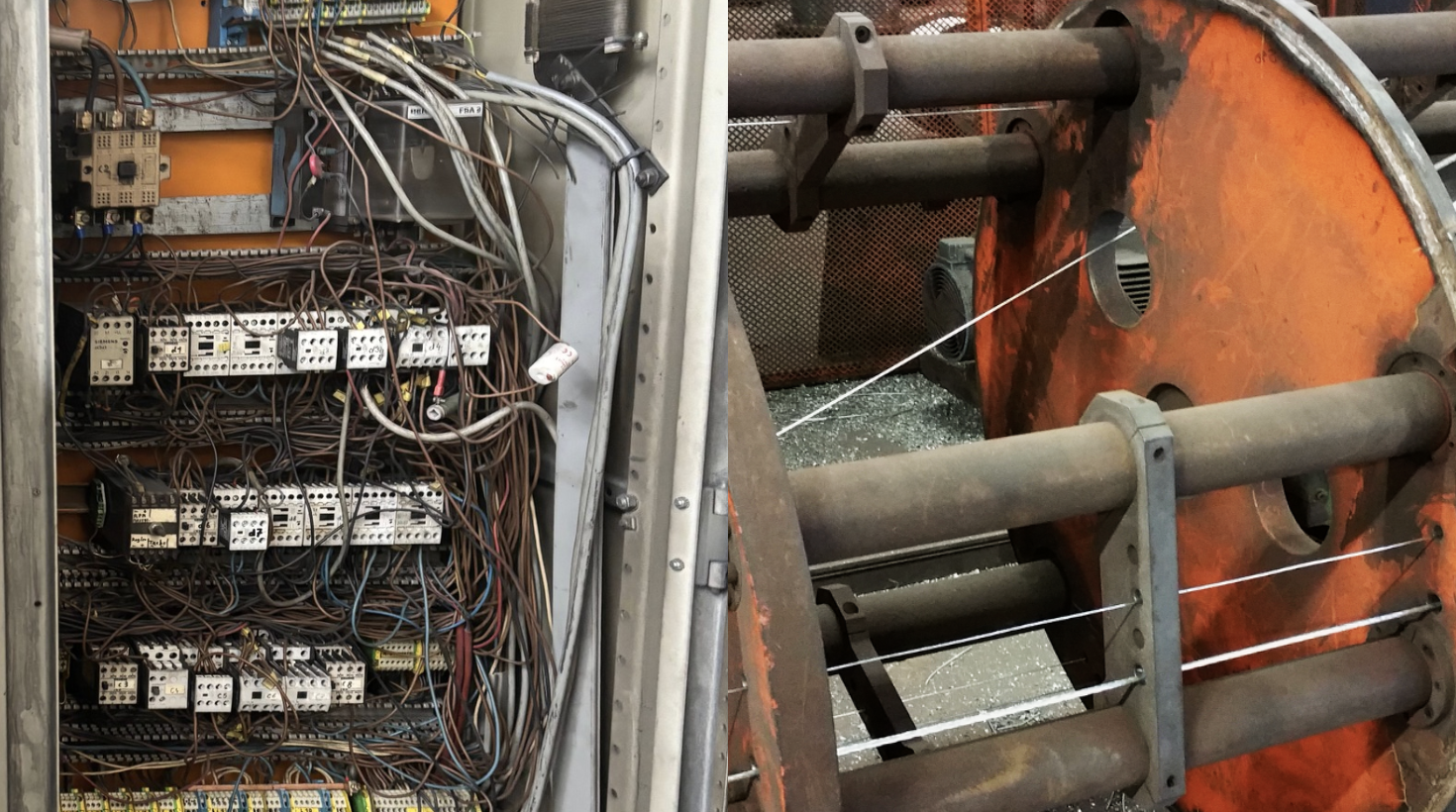
Engineered for your existing lineRETROFIT SERVICES
WIRE & CABLE INDUSTRY technical service
Facing production issues?
Get direct diagnostic support from our engineers.
We evaluate mechanical and electrical problems immediately.
- MACHINE ANALYSIS
- SOFTWARE SUPPORT
WHY RETROFITINSTEAD OF REPLACE?
Buying new machinery is not always the right answer — and in the wire and cable industry, it is often not even the most productive one. In many plants, the mechanical core of a wire drawing line, stranding machine, or extrusion unit remains structurally sound long after its control systems, drives, and electrical architecture have become a liability. A targeted machine retrofit addresses exactly the systems that are limiting performance, while preserving the capital already invested in the machine’s structure, tooling, and plant integration.
For manufacturers operating proven European machinery — Niehoff, HENRICH, SAMP, Stolberger, Maillefer, QUEINS, and others — a well-engineered retrofit typically delivers 80% of the performance improvement of a new line at 30 to 50% of the cost, with significantly less installation time and production disruption. The decision comes down to one question: is the machine’s mechanical foundation still sound? If it is, modernization is almost always the right path.
The most common trigger is an obsolete or discontinued control platform. When a PLC, drive controller, or HMI panel is no longer supported — Siemens S5 systems are a typical example across many cable plants — every failure becomes a race against spare part availability. Migrating to a current platform eliminates that risk entirely and restores access to a full support ecosystem, modern diagnostics, and remote connectivity.
Chronic unplanned downtime and safety compliance gaps are equally critical signals. Recurring mechanical or electrical failures typically point to aging components operating outside their original performance envelope — worn drives, degraded sensors, deteriorating wiring. At the same time, older wire and cable machinery rarely meets current CE or UL machine safety standards, creating liability exposure and limiting access to regulated markets. A well-scoped retrofit addresses both in a single intervention.
In every case, the right starting point is a thorough technical assessment. We evaluate mechanical condition, control architecture, drive systems, safety gaps, and production requirements together and give you a clear, honest recommendation on what to modernize, what to preserve, and what the expected return on that investment looks like.
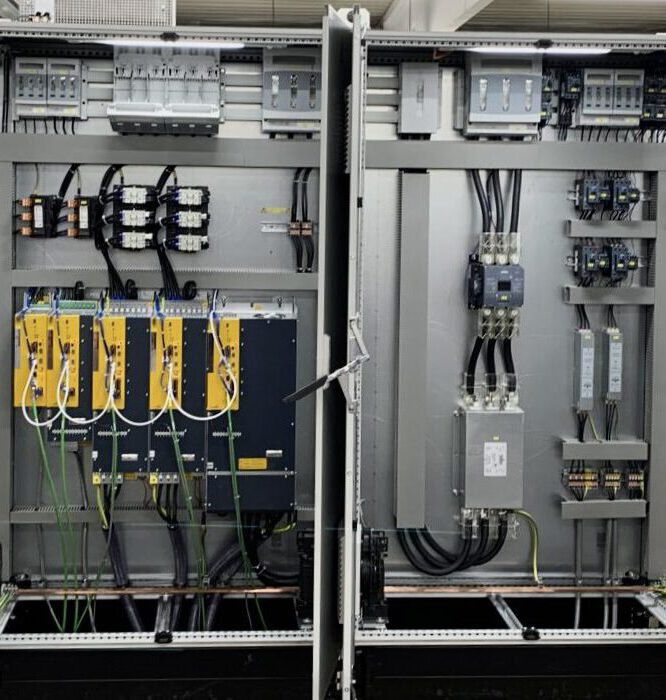
CE & UL COMPLIANCE
Built to current safety standards

Up to 15%
Energy Savings

Up to 70%
Lower Cost vs. New Equipment
RETROFIT PROCESS
01
TECHNICAL ASSESSMENT
02
ENGINEERING DESIGN
03
HARDWARE PROCUREMENT
04
ON-SITE
INSTALLATION
INSTALLATION
05
COMMISSIONING
& TESTING
& TESTING
06
DOCUMENTATION
& TRAINING
& TRAINING
FAQ
1. How does the cost of a machine retrofit compare to buying new equipment?
A wire and cable machine retrofit typically costs between 30% and 70% of an equivalent new machine, depending on scope. A control system upgrade on a wire drawing line — replacing an obsolete PLC, drive systems, and HMI — generally sits at the lower end of that range. A full mechanical and electrical retrofit of a stranding or extrusion line sits higher, but still delivers significant savings compared to new equipment procurement.
Factor in the lead time for new machinery (which can run twelve to eighteen months for custom-built wire and cable production lines), installation costs, plant layout modifications, and the ramp-up period on an unfamiliar machine, and the economic case for retrofitting a structurally sound asset becomes clear. For most manufacturers, the return on a well-scoped retrofit is measurable within one to two production years.
2. What happens to my Siemens S5 or other legacy control system during a retrofit?
Siemens S5 migration is one of the most common retrofit requests we handle in wire and cable plants across the world. The S5 platform has been discontinued for decades, and spare parts — particularly CPUs, I/O modules, and communication cards — are now difficult to source reliably and carry significant price premiums.
Our process involves a full program audit of the existing S5 logic, translation and optimization of that logic to Siemens S7 or TIA Portal, hardware replacement, and complete recommissioning under production conditions. The same approach applies to legacy Allen-Bradley, Parker SSD, and other discontinued platforms. We do not simply swap hardware — we use the migration as an opportunity to improve the control logic, update the HMI to modern standards, and add diagnostics that the original system could not support.
3. Can a retrofit help me manufacture new cable types or increase throughput?
Many retrofit projects are driven not by failure but by production opportunity: a new cable product, a larger conductor range, a higher throughput target, or a shift to a different insulation material that the machine’s current configuration cannot handle. Retrofitting the control system, drives, and tooling to accommodate new process parameters is almost always faster and more economical than procuring new equipment — particularly given that lead times for custom-built wire and cable production lines can run twelve to eighteen months.
With experienced engineering support, the result is a machine that performs to specification from day one of the new product run, with full documentation and your team trained on the upgraded system.
4. How much production downtime does a retrofit require?
This depends on scope and on how well the project is planned — which is why engineering preparation matters as much as the installation itself. For a control system retrofit on a single wire drawing machine or stranding line, planned downtime typically runs five to ten working days for installation and commissioning, provided that panel pre-fabrication, program development, and hardware procurement are completed before the installation window opens.
For larger scopes — full mechanical and electrical retrofits on multi-machine lines or extrusion systems — we develop a phased implementation plan that allows partial production to continue during the work. We do not begin on-site installation until engineering is complete and all hardware is on-site and verified, because improvised delays during a planned production stoppage are the most expensive outcome for everyone.
5. Does a retrofit reduce power consumption?
Replacing aging DC drive technology with modern AC variable frequency drives is one of the most reliable sources of energy savings in a wire and cable plant retrofit. Modern AC drives with regenerative braking recover energy during deceleration that older systems dissipated as heat. Combined with optimized motor sizing, improved power factor correction, and more precise speed and tension control, a drive modernization retrofit on a wire drawing line typically reduces energy consumption up to 15% depending on the original system’s age and condition.
For extrusion lines, additional savings come from upgraded temperature control systems that reduce thermal overshoot and stabilize barrel and die temperatures, which also improves insulation quality and reduces scrap.
6. Can you retrofit machinery from manufacturers you have not worked with before?
Wire and cable production machinery follows consistent engineering principles regardless of the manufacturer — the physics of wire drawing, stranding geometry, extrusion die behavior, and take-up tension management are the same whether the machine was built by a well-known European brand or a regional manufacturer from Asia or America. Our team assesses each machine on its own technical merits.
We have successfully retrofitted equipment from a broad range of manufacturers beyond the main European names, including machinery with incomplete original documentation — a situation that is common with older machines and one our engineers are experienced in resolving through direct inspection and reverse engineering of control logic. If you have a machine whose brand or model you are uncertain about, contact us with the available details and we will give you an honest assessment of retrofit feasibility.
7. What documentation and support do I receive after a retrofit is complete?
A retrofit is only complete when the machine is documented. At project close, We deliver a full updated documentation package: revised electrical wiring diagrams, PLC program backup with source code, HMI project files, drive parameter backups, updated mechanical drawings where applicable, the safety risk assessment, and a maintenance and spare parts guide for the new system. This documentation is yours — stored in your formats, organized for your maintenance team.
We also provide hands-on training for your operators and maintenance engineers covering the new control system, HMI navigation, alarm handling, and first-level troubleshooting. After handover, our team remains accessible for remote support for questions, parameter adjustments, and any issues that arise during the ramp-up period following installation.